


Want more information? Browser our range of remote monitoring and control devices here:

Power Control Concepts
There are several reasons why dynamic generation management is required - the most frequent two reasons are due to regulatory restrictions on exporting power from a location, and co-generation with a backup power source such as a diesel or gas generator.
Power Limiting With Grid-Tie Plants : Zero Feed-In
When a solar power plant is installed on a building, it will generate the maximum power that it can at all times regardless of the current building load.
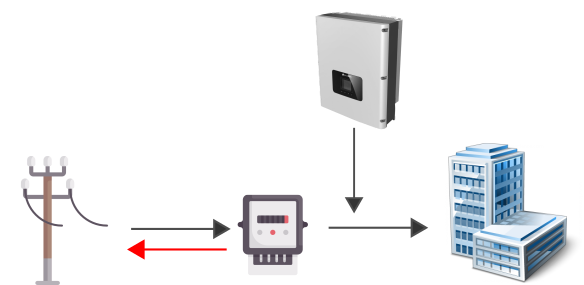 Figure depecting the utility grid at the left, a bidirectional energy meter and a solar inverter and building load at the right
Figure depecting the utility grid at the left, a bidirectional energy meter and a solar inverter and building load at the rightIn many areas of the world it is not permitted to export power to the utility grid. In these locations it is crucial to be able to regulate the power on the solar plant to ensure that it is always less than or equal to the building load.
The Wattmon monitoring solution connects to the energy meter and inverter via a communication protocol called Modbus and dynamically regulates the generation on the inverter to meet predefined set points, thus ensuring that no power is exported.
Power Limiting With Generators : Genset Protection
Solar power plants can be run while a genset is active but it is crucial to ensure that a minimum load on the generator is maintained at all times. Due to this many power plants are simply shut off when a backup energy source is activated.
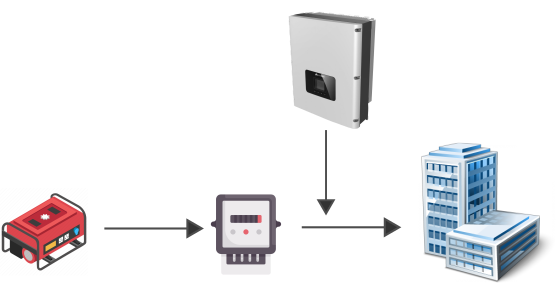 Figure depecting a genset at the left, a unidirectional energy meter and a solar inverter and building load at the right
Figure depecting a genset at the left, a unidirectional energy meter and a solar inverter and building load at the rightThe Wattmon monitoring solution connects to the energy meter and inverter via a communication protocol called Modbus and dynamically regulates the generation on the inverter to meet predefined set points (usually about 30% of the generator rated capacity), thus ensuring that minimum loading is always maintained on the generator.
Reactive Power Compensation : PF Correction
Most inverters have the ability to generate reactive power in addition to active power. Wattmon has an option to automatically calculate a reactive power value for each inverter to be able to compensate the reactive power on the loads. This is done by reading the energy meter at the power source (grid, or genset) and using the reactive value on the meter along with inverter reactive power values calculate the ideal reactive power generation value for the inverter. This is done continuously and allows for both active and reactive power compensation, thus increasing your average power factor on your meter.
Multiple Control Groups : Clusters
More complex grids may have multiple energy sources and bus couplings that make the task of a single power controller difficult. Wattmon lets you set up multiple control groups that will handle the power control tasks group-wise, which effectively gives you great flexibility in your control strategy.
For example, image a factory with a main grid incomer, 2 gensets and 4 inverters. Let's say that during normal operations, all 4 inverters are connected to the grid. An energy meter in group 1 there would be used to control all 4 inverters to ensure zero feed in to the grid.
Now during a power cut, the factory is split into two separate grids - inverters 1 & 2 are powered by genset 1. Inverters 3 & 4 are powered by genset 2. The Wattmon can now ensure that both of these groups are independently controlled, ensuring no backfeeding to the genset. Once the power is restored, all the inverters will then become part of group 1 again and be controlled together.
For example, image a factory with a main grid incomer, 2 gensets and 4 inverters. Let's say that during normal operations, all 4 inverters are connected to the grid. An energy meter in group 1 there would be used to control all 4 inverters to ensure zero feed in to the grid.
Now during a power cut, the factory is split into two separate grids - inverters 1 & 2 are powered by genset 1. Inverters 3 & 4 are powered by genset 2. The Wattmon can now ensure that both of these groups are independently controlled, ensuring no backfeeding to the genset. Once the power is restored, all the inverters will then become part of group 1 again and be controlled together.